
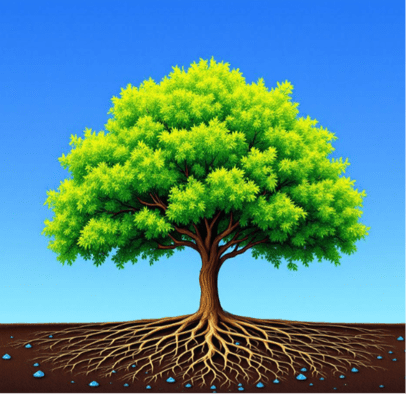
A healthy landscape depends on the intricate connection between soil, water, and the trees and plants that depend on those resources. Soil health and structure especially serve as the foundation for this relationship, determining how water moves through the ground and becomes accessible to trees.
This article will explain more about soil and its relationship with water and trees. Understanding how they work together can help you make informed decisions that will help you keep your trees healthy while sustainably managing your yard and property.
Water and Trees: Why Water is So Important
Water is an essential life-giving substance for nearly every living organism on earth, but it holds special significance for trees. On average, trees are composed of more than 50% water, which is crucial for maintaining their structure, health, and metabolic processes.1
Why Trees Need Water
- Photosynthesis: Water is a key ingredient that enables trees to harness sunlight and convert atmospheric carbon into sugars, providing the energy needed for growth and health.
- Nutrient Transport: Trees use water to move nutrients from the soil to various parts of the tree.
- Cell Structure: Water maintains cell turgor, offering structural support throughout the tree.
- Temperature Regulation: Through transpiration, trees use water to cool themselves and regulate their temperature.
- Growth and Development: Sufficient water is essential for the growth of roots, stems, and leaves.
- Stress Resistance: Adequate water helps trees withstand environmental stresses such as excessive heat and drought.
Take a Surprising Look at Tree Roots
A tree’s roots serve many functions and are inextricably connected to its health and stability. But while it is widely known that trees access water through their roots, their root growth patterns are often misunderstood.
The classic hour-glass image of a tree’s root system mirroring a tree’s canopy and plunging deep underground is not accurate for most trees. Instead, tree roots grow in ways that may surprise you.
Three Key Facts About Tree Roots
- Tree Roots Are Remarkably Shallow
The majority of tree roots grow to very shallow depths, usually extending only 12 to 18 inches deep, with most absorbing roots found only in the upper inches of soil.2
- Tree Roots Spread Far and Wide
A tree’s roots often extend far beyond its canopy, sometimes reaching two to five times the diameter of the tree’s dripline.3
- Water-Absorbing Roots Are Fine and Fragile
A tree’s roots responsible for absorbing most water and nutrients are extremely thin and delicate, and can be easily injured from lack of moisture, suffocation, or mechanical damage.4
Tree Roots Grow This Way for a Reason
The soil environment plays a crucial role in shaping the development of trees, as it provides water - as well as oxygen - and most of the essential nutrients trees need to live and grow. Most of a tree’s roots only grow in the upper layers of soil because this is where they have the greatest access to these life-giving elements.
In deeper soil layers, these resources usually are sparse, so in most cases a tree’s absorbing roots do not grow far below the soil’s surface. So, to overcome this limitation, they will spread outward, accessing a wider area for water and air.
Soil Structure Influences Trees
The growth patterns of tree roots are not only influenced by the resources that are present in the soil, but also by how the soil is built - or structured - to make these elements available. This architecture is critical to a tree’s health and survival, because without structure, the vital resources that a tree needs to survive will not be available.
What Creates Healthy Soil Structure
Healthy soil structure develops when mineral materials - tiny or even microscopic pieces of rocks and minerals called soil particles – are bound (or aggregated) together, leaving open spaces (or pores) between them.
This frequently occurs naturally in environments undisturbed by human activity, such as woodland forests, where organic matter and living soil biology are abundant. Organic matter (residues sourced from fallen leaves, twigs and other plant materials) is especially good at sticking to mineral particles and clustering them together.
Organic matter also attracts and adheres to water which additionally enhances the water storage capacity of a soil. Meanwhile, the movement of soil organisms works to create and maintain even more pore spaces, further enhancing a soil’s structure and permeability.
Take a Closer Look at Soil Structure and Water Movement
When structured well, healthy soil has a physical arrangement that somewhat resembles a sponge. It is filled throughout with a mixture of large spaces (called macropores) that usually hold air - and small spaces (aka micropores) that store water.
With heavy watering or rainfall - much like a sponge that has been completely soaked - all of a soil's pore spaces may fill up with water, until a soil reaches its saturation point. However, within a short period of time after water inputs have stopped, much of the water in the larger macropores drains out. This is known as gravitational water - and after draining it is no longer available for trees to absorb.
What remaining water is available is held in the smaller micropore spaces. Attracted by forces of cohesion, this is known as capillary water. For most of their water needs, especially in the long term, trees rely on the capillary water that is stored in the smaller micropores - while air is primarily held in the larger macropores. Both water and air are important for tree health.
The Impacts of Flooding and Drought on Tree Health
A stable supply and appropriate balance of both water and air within the soil are essential for the overall health and vitality of trees. If soils remain saturated with water for long periods, as can happen during ongoing flooding, oxygen within the root zone is depleted. This oxygen deficiency makes it challenging for tree roots to function properly, causing considerable stress and potentially threatening the tree's survival.
Conversely, in times of drought, rainfall may be infrequent, and even when it does occur in heavy bursts, intermittent rainfall may not provide lasting water reserves in the soil. This is because much of this water is lost as gravitational water, draining away before it can be stored for long-term use. As a result, these sporadic rain events are often insufficient to supply trees with the moisture they need during extended dry periods.
In both situations, prolonged flooding and infrequent rainfall can damage tree roots and expose trees to severe stress, jeopardizing their health and longevity.
When Soil Structure Falls Apart - The Dangers of Soil Compaction
Soil compaction also presents a significant threat to soil and tree health. When soils are disturbed or compressed, their structure can deteriorate. This reduces the soil’s ability to infiltrate, drain, and store moisture and air. Such conditions are common in residential landscapes, where soils endure human activity like construction, foot traffic, or the use of heavy landscape equipment.
Inspired by Nature, Monster’s Soil Health Program Restores Health - and Structure - to Soil and Trees
Thankfully, there are ways to improve soils that are damaged by compaction, remedy conditions like poor drainage, and protect trees that are prone to both flooding and extended drought.
Monster’s Soil Health Program harnesses natural processes to rebuild soil structure and vitality, so that soil works with trees the way that Nature intended. By introducing organic materials and fostering beneficial soil biology, Monster’s approach mimics the ideal soil conditions found in natural environments. As a result, with our Soil Health Program, your landscape can regain its ability to sustain healthy, beautiful, resilient trees.
Healthy soils support healthy trees! Restore life-giving structure and health to your soils, trees, and landscapes. Call your Monster Tree Service and request our Soil Health Care services today!