
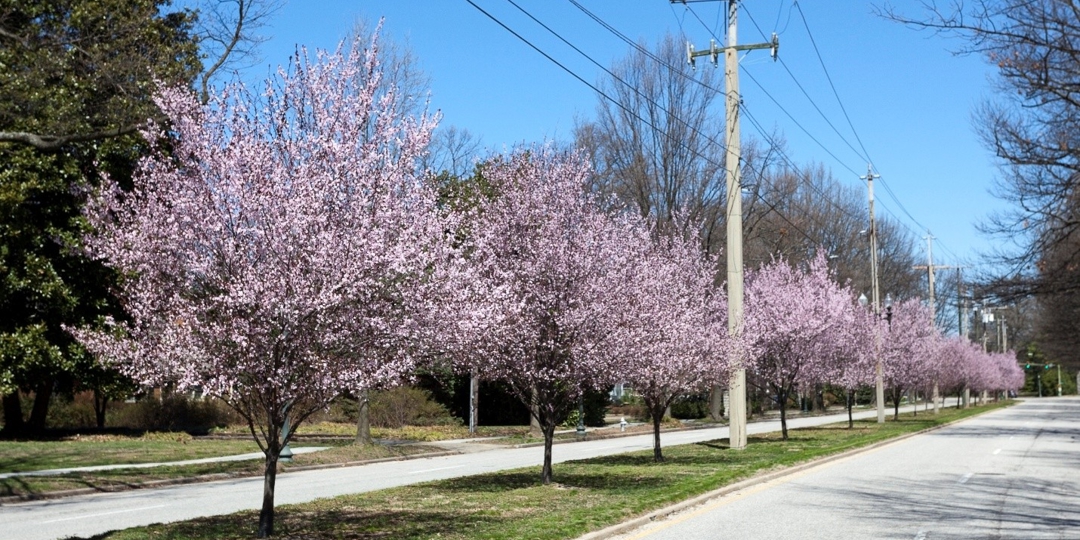
Trees are a valuable part of our landscapes, providing shade, beauty, and environmental benefits. However, when planted too close to utilities such as power lines, water pipes, or communication cables, trees can cause significant problems. Whether overhead or underground, tree branches and roots may compete for space with utility lines and could cause dangerous conflicts that result in disfigured canopies, service interference, and costly damage.
Not all trees pose threats to utilities. Fortunately, there are many trees that can grow and mature within utility constraints while still contributing beauty and function to a landscape. Numerous options exist that can provide shade, privacy, flowers, fall color, and many other beautiful seasonal features that will enhance your property, all while avoiding confrontations with utility lines.
With careful planning, you can choose a beautiful tree that will fit within the boundaries of the utilities that serve your home and neighborhood. In this article we will offer some helpful planning guidelines and give you a list of some fabulous trees that are small in size - but big on aesthetic impact – and may make good choices for plantings in proximity to utility lines.
Find the Right Tree for the Right Place
It is possible to plant a tree or shrub if there are utility lines nearby. However, knowing the whereabouts of service installations in the area where you plant is crucial to choosing and planting the right tree safely and successfully.
Poor tree choices generally do not work out well either for the tree or for utility lines that are located too close to it. Nearby tree branches can break and fall on overhead lines, causing damage and interrupting service delivery.
Trees coming in contact with utilities can even become energized, turning an entire tree into an electrical safety hazard. Underground roots can invade and damage underground water pipes, gas lines, electrical wires, and communication cables, leading to expensive repairs and inconvenient service disruptions that may affect you and your neighbors.
It is generally unwise to assume that an oversized tree can be continually pruned to keep its height in check under a power line. Topping and drastic over pruning can cause a tree significant stress,1 and pruning near energized lines poses dangerous safety risks for tree workers.
In fact, according to ISA and TCIA’s accepted ANSI Z133 Safety Requirements and ANSI A300 Tree Care Standards, tree trimmers without specialized utility clearance qualifications are not allowed to work within 10 feet of utility lines or even work in trees with branches that are within 10 feet of nearby utilities.
Ultimately, good site analysis, proper planning, and appropriate tree selection may prove invaluable to support both the longevity of the tree and keep your utility services running safely and smoothly.
Don’t guess about underground lines: Call 811
When deciding on a planting location, never assume that you know what is running underground – digging mistakes may not only be costly, but potentially deadly if either direct or indirect contact is made with live wires and cables. When making tree planting plans, placing a call to 811 is your first and most important step to make sure that your planting goes safely and successfully.
You can either make a phone call by dialing 8-1-1 or go to the online 811 website at 811beforeyoudig.com to make an appointment to have your underground utilities marked for free. Usually within a day or two a representative will come out to your property to meet with you, and your utility lines will be marked with a flag or spray paint.
Understand how tree roots grow
Even though a tree’s roots may grow wide, they generally don’t grow very deep, usually only reaching a depth of two or three feet, with the majority of roots concentrated in the upper inches of soil. Unfortunately, most underground utilities - including electricity, water, gas, and cable lines - are also installed at similar depths, putting service lines and tree roots into direct areas of conflict.
Tree roots also have a tendency to grow wide, often extending outwards well beyond the canopy dripline. Knowing the mature width of a tree is important to consider because it will reflect the potential spread of the tree’s roots, which below ground may at least double, if not triple, the diameter of its canopy.
Potential root growth therefore should be taken into account when deciding where to plant your tree if underground utilities are nearby. At minimum, planting holes should not be dug any closer than 10 feet away from a marked utility line.
This distance may increase considerably based on the mature size of the tree and if the tree’s roots tend to grow aggressively. If you have questions about tree selection and underground utilities, ask your Monster Arborist for guidance.
Prevent tree and overhead utility line conflicts
Proper planning and placement of trees are essential to minimize conflicts with overhead utility lines. When selecting a planting site, it is important to consider the mature height of the tree and its proximity to lines overhead.
Heights of overhead utility lines may vary from location to location, and it is important that you are aware of the clearance distance on your property and your local utility easements when making a tree planting decision.
Many municipalities and local governments have tree lists and recommendations for utility planting. Following recommendations and adhering to local ordinances will help ensure the safety and reliability of overhead utility lines while allowing for healthy tree growth.
Be aware of height restrictions when planting near or directly below overhead lines
As a general rule, trees should be planted at a distance from the pole-to-pole center line that matches the tree’s expected mature height. For instance, if a ‘Sunset’ red maple (Acer rubrum ‘Sunset’) is anticipated to reach 50 feet at maturity, it should be planted at least 50 feet away from the center line between the poles.2
Generally, trees that grow taller than 25 feet at maturity should never be planted directly underneath power lines or within 20 feet of the pole-to-pole center line.3 This restriction is common but may vary, and before planting directly underneath a service line, you should check with your utility provider or local municipality for specific utility easements in your area.
Know your utility company’s recommendations and planting zones
Your utility company may have guidelines specific to your town or city, but they often assign planting recommendations in three zones adjacent to power line easements. These zones help ensure public safety and reliable electrical service by minimizing the risk of trees interfering with overhead lines.4
These three planting zones are often designated, but may vary, as follows:
- Low zone: Only small-statured trees, which reach a mature height of up to 25 feet, should be planted under or within 20 feet of the pole-to-pole center line. This prevents trees from growing into or too close to the lines, reducing the need for frequent trimming or removal.
- Medium zone: This area spans from 20 to 50 feet adjacent to the pole-to-pole center line. In this corridor, you can plant both small and medium-sized trees or specifically, any tree that will reach a mature height of 40 feet or less. Following these recommendations helps maintain a safe distance between vegetation and utility lines.
- Tall zone: This zone begins 50 feet or more from the utility easement. Beyond 50 feet from overhead lines, you can plant any type of tree you want. However, it's important to keep in mind any additional guidelines or rule-of-thumb suggestions provided by your utility company for safe and responsible planting.
Research your tree
Once you know about the utility restrictions of your planting area, the next step is to find an appropriate tree that will grow well in its designated site while avoiding conflict. There are many tree species that can grow happily within a small or constrained space, and there are even dwarf cultivars of large tree species that may be the perfect candidate for placement near utility lines.
You can check out a number of resources to find information about a tree’s projected height at maturity and its canopy width. This information may be indicated on its nursery label, or you can find information on state extension and other horticultural websites. Your Monster Arborist will also have extensive knowledge about utility friendly trees that grow well in your area.
Know your tree cultivars
Also be careful to consider the species cultivar as much as the tree species itself. Within a tree species there can be a number of varieties that have considerable size variations.
For instance, the size of a ‘Teddy Bear’ Magnolia (Magnolia grandiflora ‘Teddy Bear’), a compact Southern magnolia cultivar, typically grows to heights from 16-20 feet tall and can spread from 10-12 feet wide. The original straight species (Magnolia grandiflora), however, towers to a height of 60-80 feet with a grandiose 30–40-foot spread.
Trees to consider
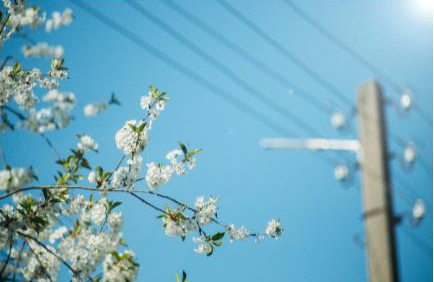
In the list below, we have picked out 16 beautiful trees that may be good choices to plant in the vicinity of utilities. When making your choice, bear in mind that growth rates may vary with different regions, climates, and site conditions.
- Redbud (Cercis species): This tree is a stunning native beauty, putting on a vivid spring show of pink and magenta flowers while remaining relatively compact, making it ideal for spaces where height restrictions are necessary. ‘Forest Pansy’ and ‘Oklahoma’ are especially notable for their shorter growth and compatibility with overhead utilities.5
- Kousa Dogwood (Cornus kousa): Kousa dogwoods are disease resistant trees that offer beautiful spring flowers, ornamental fruit, and vivid fall color. Many cultivars of this tree grow to smaller heights that make them an ideal fit for confined spaces.6
- Japanese maple (Acer japonica): With its delicate foliage and wide variety of cultivars, the Japanese maple adds refined beauty to a landscape without overwhelming a limited planting area.7
- Holly cultivars (Ilex species): A number of holly species and cultivars are ideal evergreen options, adding benefits of both privacy and year-round beauty to a landscape, all the while staying within safe size limits for utility proximity. ‘NellieR. Stevens’ (Ilex x ‘Nellie R. Stevens’) and ‘Fosters’ holly (Ilex x attenuata 'Fosteri')are popular easy-care varieties, bearing red winter fruit without the need for a male pollinator partner. Another fantastic option is Yaupon holly (Ilex vomitoria), a small, low maintenance tree native to the Southeastern US, which is gaining landscape popularity for its festive red berries backdropped against a finely textured canopy of smooth, evergreen leaves.8
- Crabapple (Malus species): Crabapples have long been favorites for their lovely ornamental flowers and fruit, and most cultivars are bred for compact growth, minimizing conflict with nearby service lines.9
- Hawthorn (Crataegus species): Native hawthorn trees are valued for their delicate spring blooms, bright fall berries, and wildlife benefits. Their compact form generally makes them suitable for urban landscapes and utility friendly plantings.10
- Purple Cherry Plum (Prunus cerasifera 'Krauter Vesuvius'): This purple plum variety is well known and loved for its easy care, exquisite early blooming pale pink flowers, deep burgundy foliage, and an especially restrained growth habit, making it both ornamental and utility friendly.11
- Japanese flowering cherry (Prunus serrulata): Several cultivars of this species make excellent choices for planting nearby overhead lines. Japanese flowering cherries are beloved for their early spring flowers, blooming delicately in shades of pink or white, which may come in single, semi-double or double forms.12
- ‘Autumn Brilliance’ Serviceberry (Amelanchier x grandiflora ‘Autumn Brilliance’): Noted for its early spring flowers, vibrant fall color, and edible berries, ‘Autumn Brilliance’ Serviceberry is a beautiful native tree that remains compact and adaptable, thriving in a variety of conditions without posing a risk to overhead lines.13
- Fringetree (Chioanthus virginicus): Fringetrees are eye-catching North American natives that produce showy, fragrant flowers in spring and typically maintain a modest size, allowing for flexible placement.14
- American smoke tree (Cotinus obovatus): With cascading flower sprays resembling billowy puffs of smoke, the native smoke tree is considered an ideal choice for planting near utility lines due to its small size and nonaggressive root system.15
- Japanese Snowbell (Styrax japonicus): Japanese Snowbell is a graceful, horizontally tiered tree with a more compact growth habit than other Styrax species, making it a safer option for planting nearby overhead utilities. This diminutive tree can be an exquisite focal point in any landscape, featuring dainty white flowers that bloom in early spring, resembling tiny white bells that dangle delicately from its branches.16
- Blackhaw Viburnum (Viburnum prunifolium): A native species with lace-like clusters of white spring flowers, stunning fall color, and dark black fall fruit relished by birds, Blackhaw Viburnum can be grown as a hedge or trained into a small tree. Its modest size makes it well-suited for utility plantings in urban and suburban landscapes.17
- ‘Teddy Bear’ Magnolia (Magnolia grandiflora ‘Teddy Bear’): A dwarf version of the monumental Southern Magnolia, this compact magnolia variety ushers classic Southern charm with its dark, glossy evergreen leaves and fragrant white flowers - all the while maintaining a manageable height suitable for tight spaces and utility easements. This tree works beautifully either as an individual specimen or planted in a row as a privacy screen with a little extra pizazz and glamorous Southern appeal.18
- ‘Emerald Green’ Arborvitae (Thuja occidentalis 'Smaragd'): Arborvitae cultivars are popular choices for evergreen privacy screens and grow in a variety of sizes. ‘Emerald Green’ is a smaller Arborvitae cultivar that offers dense evergreen foliage and a narrow columnar shape, making it ideal for planting without risking interference with nearby overhead wires.19
- Junipers (Juniperus species): Junipers are a versatile group of conifer evergreen trees that grow well in many areas of the US, and many smaller varieties can be safely planted for utility clearance. They make especially attractive landscape additions, showcasing a remarkably wide array of colors including deep greens, silvery blues, and even golden hues.20
Need help deciding? Put your trust in Monster Tree Service’s Tree Care Experts.
If you have questions about planting suitable trees on your property, feel free to consult with your Monster Arborist for expert recommendations you can trust. We are always ready to assist you with our Professional Tree Planting Services, where we’ll work with you from start to finish to make your tree planting dreams become a reality.